Custom Cold Forged Heat Sink Manufacturer
HeatsinkMaker designs, prototypes, and mass-produces cold forged heat sinks and thermal assemblies for engineering-driven OEMs. We develop production-ready solutions around your thermal, mechanical, and cost targets.
35:1
Maximum fin aspect ratio*
2014
Serving OEM engineering teams
2D + 3D
Drawing-led development
Materials
AL6063 / C1100
Production
Prototype to volume
*Application-dependent and subject to design validation.
Process advantage
Why choose a cold forged heat sink?
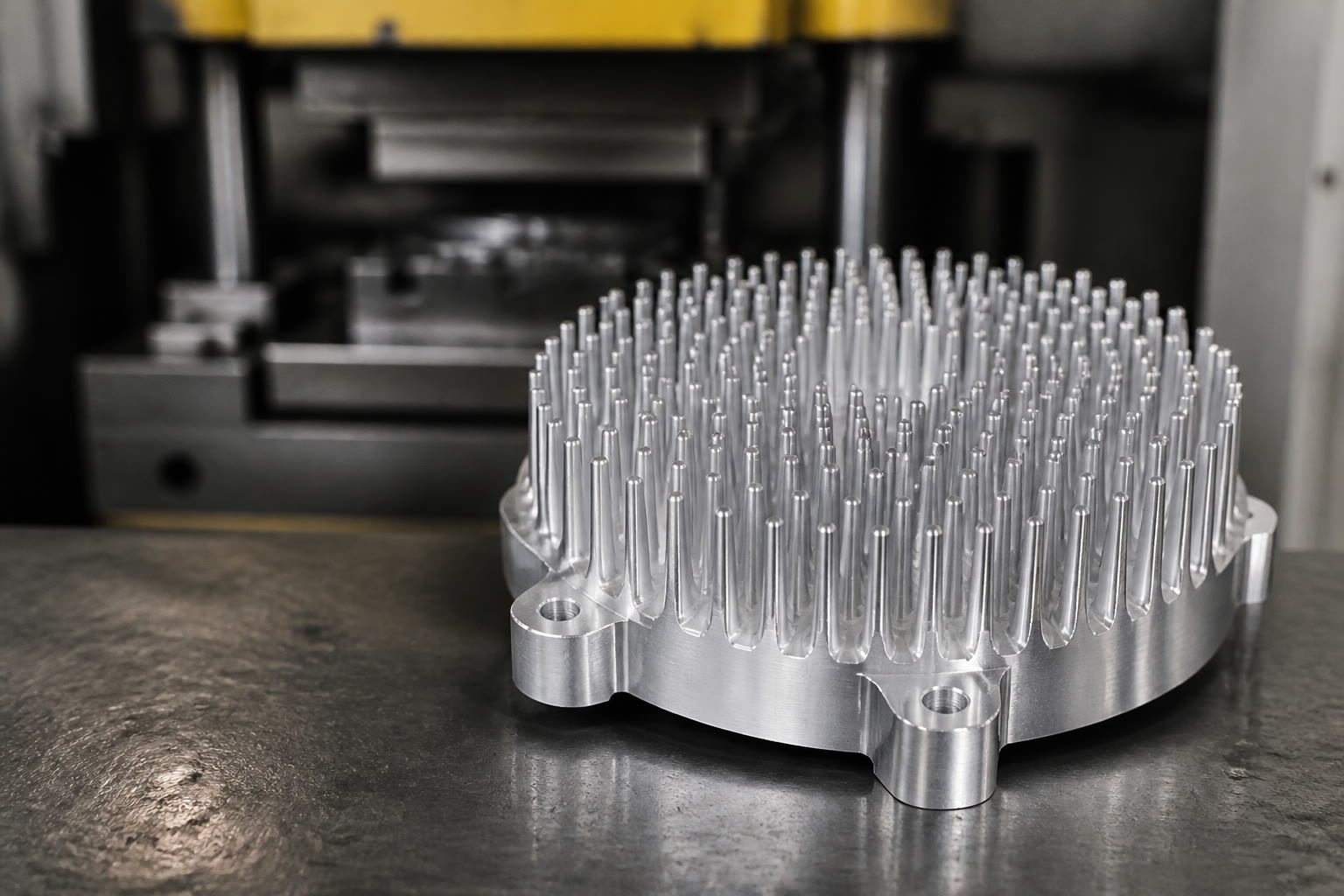
Cold forging forms the fins and base from a single aluminum or copper slug through room-temperature deformation. This integral structure creates an efficient thermal path, high fin density, and durable mechanical connection without a thermal interface between fins and base.
High thermal efficiency
Integral fin-to-base construction supports low thermal resistance and greater surface area.
Robust construction
Strong mechanical integrity is suitable for vibration, shock, and demanding industrial environments.
Flexible fin geometry
Round, oval, straight, or mixed geometries can balance airflow behavior and cooling performance.
Production economics
Once tooling is validated, the process is cost-effective for medium-to-high volume programs.
Manufacturing capability
Cold forged heat sinks engineered for integration
Our team combines process knowledge, secondary machining, finishing, and assembly support to deliver components that fit your thermal system and production flow.
| Materials | Aluminum 6063 and Copper C1100 (Cu1100) |
|---|---|
| Maximum fin aspect ratio | Up to 35:1, application-dependent |
| Fin geometries | Round, oval, straight, or mixed |
| Design detail | No fin draft angle required for suitable designs |
| Secondary processing | CNC machining, drilling, tapping, turning, cutting, deburring, and finishing |
| Typical applications | LED, power electronics, motor controllers, and inverters |
Machining and assembly
Mounting features, fan and blower interfaces, hardware installation, and cleaning tailored to your flow.
Heat pipe integration
Copper heat pipe insertion with soldering or brazing to spread heat across larger forged fin fields.
Hybrid thermal solutions
Skived, extruded, bonded fin, brazed assemblies, and liquid cold plates for alternative requirements.
Engineering support
From thermal requirement to production-ready design
A high-performing heat sink is a system-level outcome. We align thermal, mechanical, and manufacturing requirements before tooling and production begin.
- ●Thermal solution development and heat sink structure design
- ●Mechanical design and DFM review to reduce risk and cost
- ●Process selection guidance across cold forging, skiving, extrusion, and other methods
- ●Thermal simulation support, prototype development, and validation testing
- ●Dimensional, thermal resistance, and pressure-drop assessment
Common engineering software: AutoCAD, SolidWorks, and Creo.
Materials and finishes
Aluminum 6063
Typical for cold forging because of its ductility, low weight, and cost efficiency.
Copper C1100
Selected when high thermal conductivity is required in a constrained envelope.
Surface finishing
Anodizing, hard anodizing, nickel plating, passivation, sandblasting, polishing, and cleaning.
We help select finishes for corrosion resistance, emissivity, and cosmetic requirements without compromising thermal performance.
Quality and scalability
Controlled from prototype through mass production
Our structured development model de-risks launch and creates a repeatable path to volume supply.
01
Prototype
Rapid tools and quick-turn samples for design validation.
02
Validation
Thermal, mechanical, and manufacturing feasibility confirmation.
03
Pilot run
Process capability and repeatability verification before launch.
04
Mass production
Stable, cost-optimized supply with consistent quality and scalable machining resources.
Inspection and testing
- Dimensional and CMM inspection
- 2D measurement and surface inspection
- Thermal resistance and airflow characterization
- Leakage and pressure testing for liquid-cooled modules
Typical CNC precision
±0.002–±0.008 mm
Machine capability supports consistent assembly fit and repeatable performance. Data packages can be aligned to your validation plan and quality standards.
Application fit
When cold forging is the right choice
Choose cold forging when you need:
- • High fin density and an integral fin-to-base structure
- • Round or oval pin-fins for multidirectional or turbulent airflow
- • Mechanical robustness for transportation, industrial, or vibration-prone environments
- • Tooling-supported lower piece-part costs at production volume
Consider alternatives when:
- • Extremely high aspect ratio straight fins are required; skiving or bonded fin may be preferable
- • Ultra-wide modules need extrusion with friction stir welding or bonded fin assemblies
- • High heat flux and tight envelopes mandate vacuum-brazed or embedded-tube cold plates
Our engineers compare manufacturing paths and recommend the most suitable solution for your performance and budget.
Markets served
Thermal solutions for demanding industries
RFQ preparation
Give our engineers the inputs to quote accurately
Share as much of the following as available. If you do not have a formal drawing, we can begin with your thermal requirements and constraints.
What to include in your RFQ
2D drawing and 3D CAD file
Heat load and allowable component temperature
Heat source size and location
Ambient temperature and airflow conditions
Available installation space and mass limits
Preferred material and finish
Annual volume and ramp plan
Testing, inspection requirements, and standards
Technical FAQ
Questions engineers ask about cold forged heat sinks
What fin geometry is best for my application?
Round or oval pin-fins work well in multidirectional or obstructed airflow. Straight fins may be preferred for aligned forced convection with a defined flow direction. We model thermal performance and pressure drop to select the best geometry.
When should I choose copper C1100 over aluminum 6063?
Choose copper for very high heat flux or when space is constrained and conductivity is critical. Aluminum offers lower weight and cost and is adequate for many forced-convection designs.
Can you add mounting features and threaded holes?
Yes. We machine mounting interfaces, countersinks, threads, and flatness-critical surfaces after forging to meet assembly tolerances.
Do you support hybrid modules with heat pipes?
Yes. We integrate copper heat pipes and perform soldering or brazing and testing as required to spread heat to larger forged fin fields.
How do you validate performance?
We combine simulation support with empirical thermal resistance testing and, for relevant assemblies, airflow and pressure-drop measurements.
Start your project
Build a production-ready cold forged heat sink
Partner with HeatsinkMaker for a custom thermal solution designed around your real-world constraints. Send your drawing and thermal requirements, and our engineering team will recommend a reliable path from prototype to volume.
HeatsinkMaker
Custom Thermal Solutions. Built for Production.